 VACUUM VERIFIED
How to choose a vacuum for your home: a decision guide
7 min read · updated August 30, 2026 · Vacuum Verified
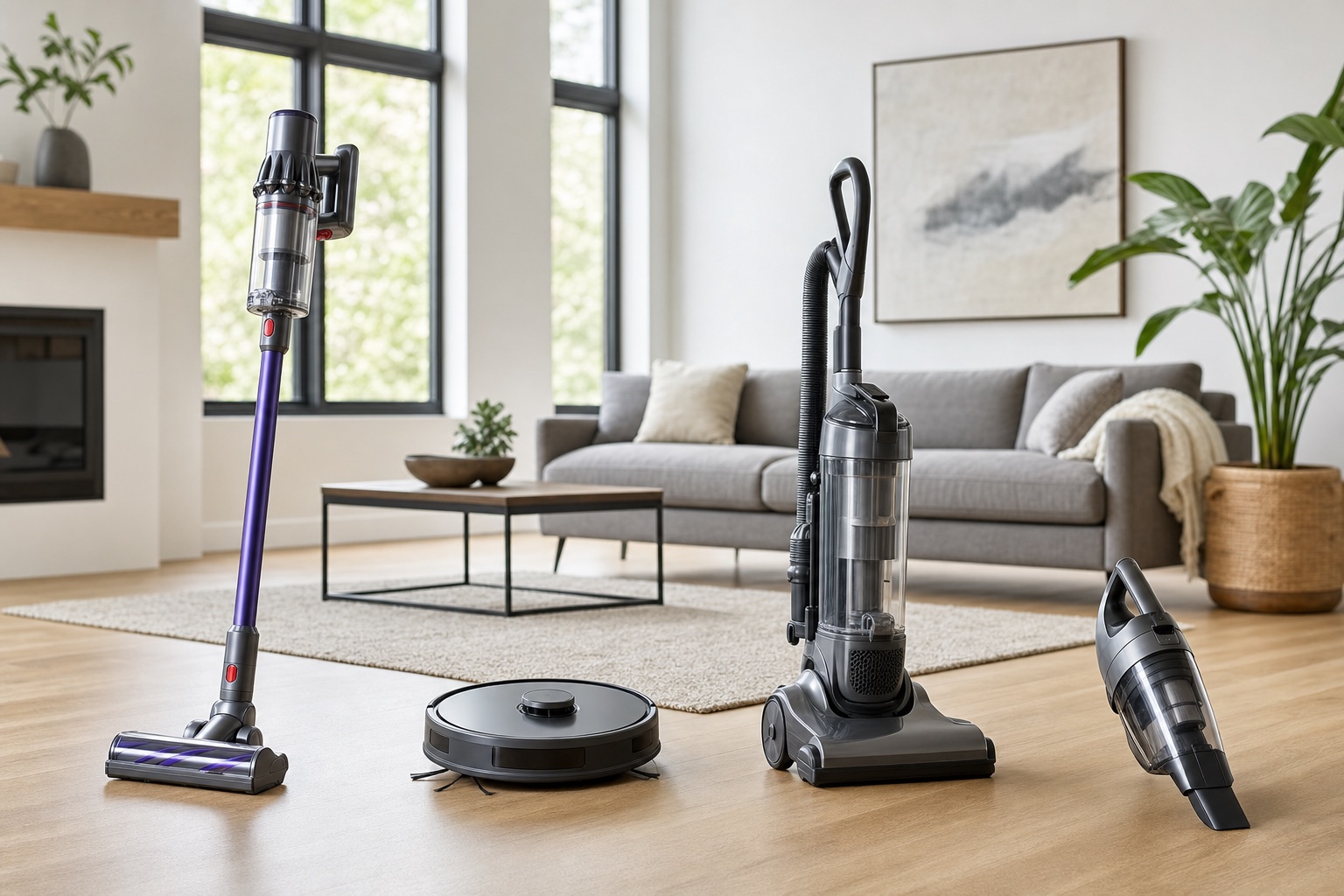
Choosing a vacuum goes wrong when people start with models instead of their own home. The right category follows from three questions — your floors, your shedding, your air — and only then should scores and prices come into it. This guide is the decision order we'd walk a friend through, with links into the rankings for each branch.
Find your match in six questions
Tell us what you're shopping for and five quick details — we'll point you at a machine type, with real picks from our tested database.
- Decide by floor type first: carpet wants agitation and sustained power; hard floors want coverage and filtration; mixed wants two machines or a versatile stick.
- Pets and allergies change the spec priorities: anti-tangle brushes and sealed filtration beat suction numbers.
- Budget bands are honest: under $200 buys genuinely good cleaning; $300-600 buys automation (docks, mapping); $600+ buys the last 10%.
- Most homes eventually want a primary machine plus one specialist (handheld, spot cleaner or robot) rather than one do-everything purchase.
Step 1: your floors decide the category
Carpet-first homes want a machine with agitation and sustained power: an upright (corded or battery) or a strong stick with a motorized head. Suction numbers matter less than the brush here; see the suction guide for why. Our upright rankings and carpet-cleaner picks cover the specialists.
Hard-floor homes have the widest choice — nearly everything works — so optimize for the chores you hate: a canister for quiet precision, a stick for grab-and-go, a robot for daily autonomy, a floor washer if sticky kitchen floors are the recurring complaint (see hard-floor washers).
Mixed floors (the most common case) want either one versatile machine with a height-adjustable head and honest carpet performance, or the honest two-machine setup: a robot or stick for daily hard-floor duty and an upright for weekly carpet deep-cleaning.
Step 2: shedding changes the spec sheet
Pet and long human hair kill traditional brush rolls by wrapping — the maintenance chore owners hate most. In shedding homes, brush design (anti-tangle fins, conical rolls, hair-cutting brushes) matters more than suction numbers. For the full design tour see the anti-tangle guide, and for machines that survive shedding homes, the pet-hair rankings for robots and sticks.
Pet accidents are a different problem: a portable spot extractor (the classic Little Green class) earns its cupboard space the first time a stain sets. It's the highest-satisfaction low-cost add-on in our testing pool.
Step 3: allergies move filtration to the top
If anyone in the home has allergies or asthma, filtration outranks everything: a sealed system (all air through the filter, no bypass leaks) with bagged emptying is the dependable default — the HEPA guide explains why the word “sealed” matters more than the word “HEPA”. The machines that pass this bar are ranked in the allergy ranking; budget sealed-bagged routes exist under $100.
Step 4: budget bands are honest
Under $200 buys genuinely good cleaning — the compromise is automation and premium filtration, not pickup. The sub-$200 ranking exists because this band is better than its reputation.
$300-600 buys automation: self-emptying robot docks, LiDAR mapping, mop wash-and-dry. This is where robots make sense for maintenance-haters — the self-emptying and mop-combo rankings live here.
$600+ buys the last 10%: flagship suction, complete docks, AI obstacle avoidance. Worth it for large homes running daily; unnecessary for small apartments — the apartment ranking is deliberately anchored under $300.
Step 5: storage, noise and the household reality
Measure your storage before falling in love: full-size uprights and canisters want a closet; sticks live in a corner; robot docks want wall space and an outlet. Noise shapes usage more than specs admit — if you vacuum while a baby sleeps or calls happen in the same room, favor quieter machines (noise is 10% of every DustScore for this reason).
Finally, be honest about who does the vacuuming. A machine that fits the person's habits beats a better machine that doesn't get used — autonomy for the reluctant, simplicity for the skeptical (our no-mop robot list exists for exactly this buyer).
Frequently asked questions
Is one vacuum enough for a whole home?
Usually not, honestly. The common high-satisfaction setup is a primary machine matched to your floors plus a specialist — a handheld for stairs and cars, or a spot cleaner for stains. Two machines under $300 total often beat one $300 compromise.
Robot or corded upright as the main machine?
Robots win on frequency (daily autonomy), uprights on depth (agitation and sustained power). Carpet-heavy homes should let an upright or strong stick be primary and treat the robot as maintenance; hard-floor homes can invert that.
Are expensive vacuums worth it?
Above ~$600 you're buying refinement, not capability: quieter runs, better apps, longer warranties. The performance-per-dollar leaders in our data live between $80 and $300 — see the ValueScore leaders on any ranking.
What should I buy first in a new apartment?
A versatile stick or compact upright matched to your floors, plus — if the floors are hard — a budget robot for daily duty. Start with the apartment ranking; it's deliberately anchored under $300.