 VACUUM VERIFIED
What is HEPA filtration (and why “sealed” matters more)
6 min read · updated August 30, 2026 · Vacuum Verified
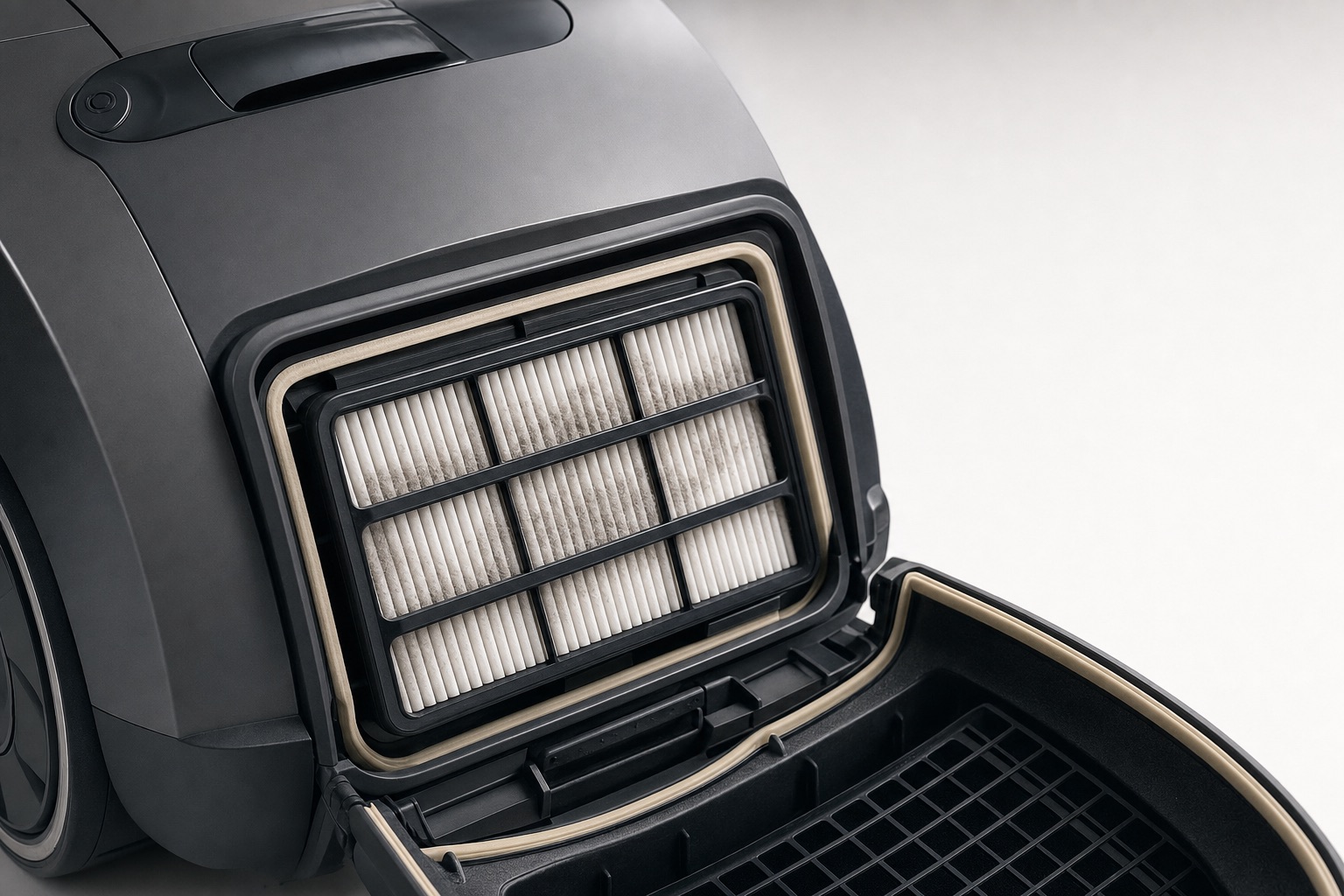
HEPA stands for High Efficiency Particulate Air. A true HEPA filter is tested to capture at least 99.97% of particles at the 0.3-micron mark — the size scientific testing considers hardest to catch, which includes fine dust, pollen, pet dander and many smoke particles. But the filter is only half the story: if the machine leaks air around the filter, the HEPA rating protects nothing. This guide explains what HEPA actually guarantees, what it doesn't, and why allergy households should shop for the word “sealed” first.
- True HEPA means the filter media captures at least 99.97% of particles at the hardest size (0.3 microns).
- A HEPA filter inside a leaky vacuum is nearly useless — air takes the path of least resistance around the filter.
- For allergies, a sealed bagged system beats a HEPA sticker: bagged emptying releases almost no dust back into the room.
- “HEPA-type” or “HEPA-like” is unregulated marketing language — treat it as “not HEPA”.
What HEPA actually guarantees
The 99.97% figure comes from the U.S. Department of Energy's standard for HEPA media, and it is measured at the filter's worst case: 0.3 microns. Particles larger than that get caught by impact and sieving; particles smaller get caught by diffusion as they random-walk through the fibers. The 0.3-micron “most penetrating size” sits in the awkward middle — if a filter beats 99.97% there, it beats it everywhere else. In European testing (EN 1822), the equivalent grades are H13 (99.95%) and H14 (99.995%).
For scale: a human hair is about 70 microns across. Fine baking flour is around 10-20 microns. The particles HEPA targets — 0.3 microns and below — are the ones that stay airborne for hours and reach deep into lungs, which is why this rating matters specifically for allergy and asthma households rather than for visible debris.
The leak problem: why “sealed” beats “HEPA”
A HEPA filter only filters the air that passes through it. In an unsealed vacuum, the motor pulls air through the path of least resistance — every un-gasketed joint, the seam around the dustbin, the exhaust bypass — and that leaky air carries fine particles straight back into the room. The machine can genuinely contain a true HEPA filter and still exhaust dirty air.
A sealed system gaskets the entire air path so that all air must pass through the filter media before exiting. Miele's AirClean sealed bags, SEBO's S-Class filtration and Dyson's whole-machine HEPA designs are engineered this way. This is the single spec worth paying for if anyone in the house has allergies — and it's why our allergy ranking is dominated by sealed bagged machines rather than whatever has “HEPA” printed largest on the box.
HEPA-type, HEPA-like and other weasel words
There is no consumer regulation governing the phrase “HEPA-type”, “HEPA-style” or “HEPA-like”. In practice those phrases mean the media resembles HEPA but was not tested to the standard — often capturing a large share of larger particles while passing far more fine ones. True HEPA either cites the 99.97% at 0.3 micron figure or a named certification (EN 1822 H13/H14). If the box won't commit to a number, assume it doesn't meet one.
Emptying: the moment most of the dust escapes
Filtration only covers the machine while it runs. Every time you empty a bagless bin over the trash, a plume of fine particles goes airborne — the turbulence of dumping re-aerosolizes exactly what you captured. Sealed bagged systems avoid this entirely: the bag is the filter, you remove it sealed, and you never touch the debris.
If you prefer bagless (no recurring bag cost), the honest mitigations are: empty outdoors or into a large trash bag you can close around the bin, and look for machines whose bin doors open downward into the trash. Sealed bagless machines (Miele's CX1, Dyson's whole-machine designs) close most of the gap at a higher price — our bagged vs bagless guide walks the full trade-off.
Care: washable filters and replacement intervals
Many HEPA filters are washable; almost none tolerate detergent or heat. The routine is tap-water rinse until the water runs clear, then a full 24 hours of air drying before reinstalling — a damp filter pushed straight back into the machine can mold or choke airflow. Replace non-washable HEPA on the manufacturer's interval (commonly 6-12 months of regular use), and sooner if you notice dust smells or reduced suction. A pre-filter (foam or mesh) exists to take the big hits before the HEPA; rinse it monthly and the expensive filter behind it lasts longer.
Frequently asked questions
Is HEPA the same as an allergy filter?
HEPA describes the filter media only. An allergy-grade vacuum needs HEPA media inside a sealed system plus hygienic emptying — a HEPA sticker alone guarantees none of that.
Do I need HEPA if I don't have allergies?
Not necessarily. HEPA matters most for fine-particle capture; for visible debris (crumbs, sand, litter), any decent machine captures it. Pay for sealing when someone in the home has allergies or asthma.
Can I wash a HEPA filter with soap?
No — rinse with plain water and air-dry at least 24 hours. Detergent residue and heat damage the media. If the manufacturer says the filter isn't washable, don't wash it.
Are robot vacuum filters HEPA?
Many robots use filters that meet HEPA-grade media specs but in compact form, and few robots have truly sealed air paths. For allergy households, a sealed bagged upright or canister remains the stronger choice; robots complement them for daily maintenance.
Machines this guide points to
Verified picks from our database mentioned in this guide — every price loads live from merchant listings.