 VACUUM VERIFIED
How robot vacuums navigate: LiDAR, cameras, gyros and “random”
6 min read · updated August 30, 2026 · Vacuum Verified
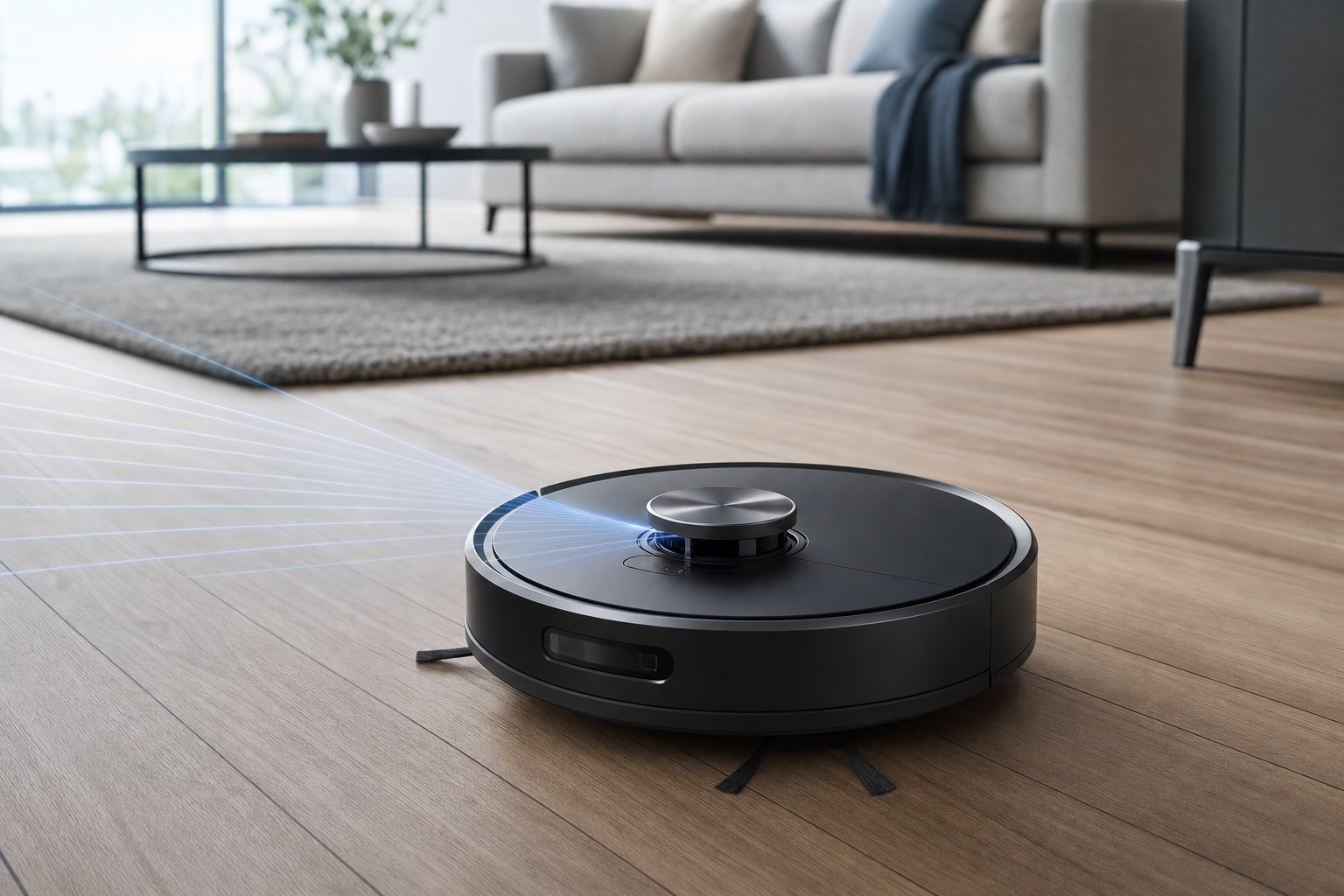
Navigation is what separates a robot vacuum from a remote-controlled fan: whether it finishes the floor, how long it takes, and whether it comes home. The spec sheet hides this behind acronyms — LiDAR, dToF, VSLAM, AI obstacle avoidance — but the underlying choices are four, and each fits a different kind of home. Here's what each actually does.
- LiDAR robots map with a spinning laser: precise routes, works in the dark, can't see transparent or floor-level hazards without help.
- Camera (VSLAM) navigation uses visual features: good obstacle sense in daylight, degraded in the dark.
- Gyro and random-bounce robots don't build true maps — they're fine for small, open floors and hopeless for large, complicated ones.
- Obstacle avoidance is a separate feature from navigation: AI recognition (pet waste, cables) is what prevents the horror stories.
LiDAR: the spinning laser turret
LiDAR (laser radar) robots carry a small rotating turret that sweeps an infrared laser, building a precise floor-plan map within a run or two. Routes are systematic — straight, overlapping lines — which makes LiDAR machines the fastest and most complete cleaners per minute, and their maps enable features like room-specific no-go zones and multi-floor plans. Because the laser uses infrared, LiDAR works with the lights off; its blind spot is physics, not light: the beam sits high and sees geometry, not meaning. Glass table legs and a sock on the floor are equally invisible without a second sensor system.
Camera navigation (VSLAM)
Camera-based robots navigate by tracking visual features of your ceiling and walls. They navigate systematically like LiDAR machines and can pair the camera with AI image recognition for genuinely useful obstacle avoidance — recognizing shoes, cables, and pet waste by appearance rather than by bumping them. The trade-off is light: cameras need illumination, so a camera-first robot cleaning at night is navigating degraded. Many premium machines combine both (LiDAR for the map, camera for obstacle meaning), which is the best of the architecture.
Gyros and random bounce: the honest budget tier
Below mapping machines sit two cheaper strategies. Gyro (“dead reckoning”) robots track their own turns and motion to approximate coverage — they run semi-systematic patterns without building a map, which is serviceable in small, open apartments and increasingly inefficient in large or cluttered ones. Random-bounce robots (the classic entry Roomba approach) simply drive until they bump, turn, and repeat; given enough time they cover a small floor, but coverage is statistical, not guaranteed, and run times balloon with floor size.
Neither is a scam — at the right price and floor size they're honest value (our no-mop ranking includes machines in this class). But if your home is over roughly 1,000 square feet or has multiple rooms and doors, buy mapping: the time savings compound every single run.
Obstacle avoidance: navigation's smarter sibling
Navigation decides the route; obstacle avoidance decides what happens when something is in it. Basic machines contact-bump and reroute. Structured-light or ToF front sensors measure distance and ease around objects. The current premium tier is AI image recognition: the robot classifies what it sees — cables, socks, pet waste — and treats hazards accordingly, some backing off entirely with a photo in the app (iRobot's pet-waste guarantee is the famous version: if it runs over pet waste, they replace the machine).
No avoidance system is perfect, and marketing photos of robots threading sock obstacle courses are staged. The practical advice: do a 60-second floor sweep before runs regardless of the sensor suite, and if your household has real floor-level hazards, weight AI recognition heavily in your choice.
Which one fits your home
Small, open, single-storey floor: gyro or random-bounce machines are honest value. Multi-room or over ~1,000 sq ft: LiDAR, for route efficiency and no-go zones. Overnight cleaning on a schedule: LiDAR (cameras want light). Floor-level hazards from kids or pets: AI obstacle recognition, whatever the navigation type. And if you want the deepest dive on machines that pair navigation with self-emptying docks, our self-emptying ranking covers that intersection.
Frequently asked questions
Does LiDAR work in the dark?
Yes — LiDAR uses its own infrared laser, so dark-floor cleaning works fine. Machines that rely on cameras for navigation are the ones that want lights on.
Do robot vacuums work on multiple floors?
Most LiDAR robots store multiple maps; you carry the robot to the other level and it recognizes which floor plan it's on. Check multi-floor map support explicitly if your home is split-level.
What is recharge-and-resume?
When the battery runs low mid-clean, the robot returns to dock, charges, then continues from where it stopped. It's essential in larger homes — every machine in our large-home ranking has it.
Machines this guide points to
Verified picks from our database mentioned in this guide — every price loads live from merchant listings.